
Trust Check
A receipt the receiver can read
- Product
-
 walllet.com
- Role
- Product Designer
- Industry
- Finance, Banking
- Year
- 2024
TL;DR
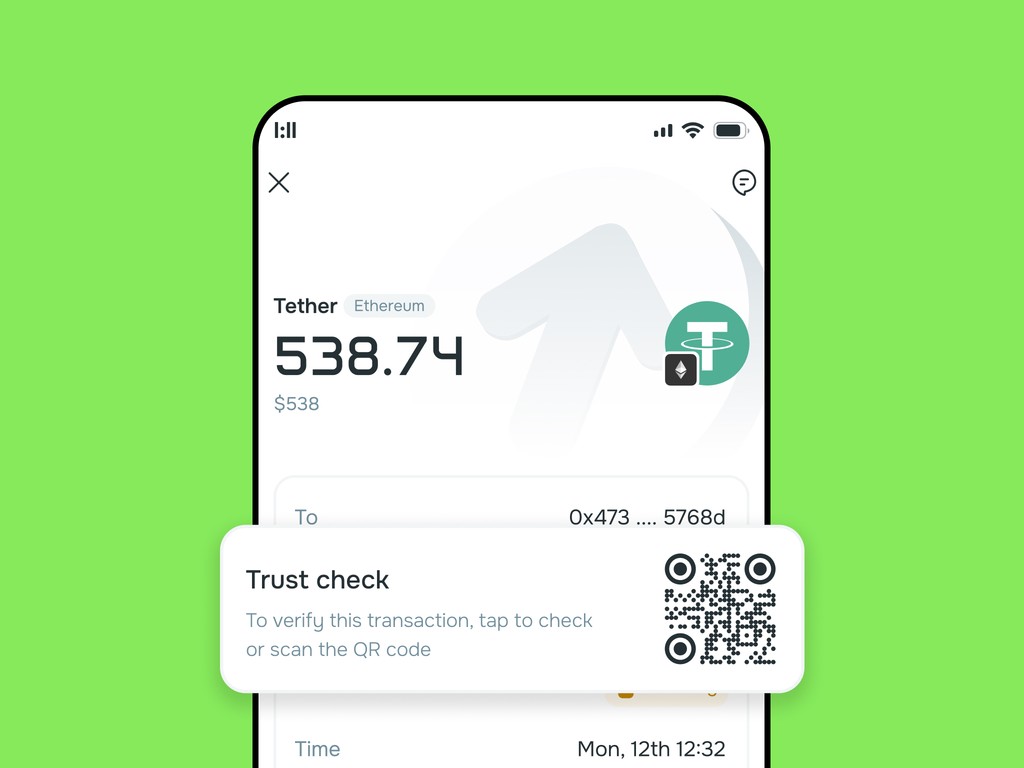
A crypto receipt ends in a 66-character hash and a link to a block explorer, a debugging tool, shown to whoever the sender forwards the receipt to. For walllet.com I replaced that with Trust check: a verifiable receipt the sender and receiver can open, carrying the amount, both parties, status, time and confirmations. The hash still exists, one layer down, for anyone who wants it.
THE PERSON ON THE OTHER END
Why a crypto receipt fails the person it is sent to
When a payment settles, the sender screenshots the confirmation and forwards it, to a freelancer, a family member, a merchant waiting to release something. That person is the whole reason the receipt exists, and they frequently have no wallet, no explorer bookmarked, and no reason to acquire either.
Crypto's proof of payment for that person is a hash and a link to a block explorer: dense, ad-supported, unbranded, built for engineers debugging transactions. It asks someone who is already unsure whether they have been paid to trust an unfamiliar third-party site to tell them. The proof exists and is worthless at the exact moment it is needed.
The problem in one sentence: our most-forwarded screen ended in a 66-character string and a link to somebody else's website.
WHAT I CUT
What I cut to make proof readable
Every decision here traded reach for restraint. A verification page is more useful the more openly it opens, more convincing the more it is branded, and easier to ship the narrower its scope and each of those pulls against either privacy, credibility, or the moment when the receiver actually needs it.
WHAT I CHOSE | WHAT I CUT | WHY |
|---|---|---|
Verification scoped to sender and receiver | A link anyone can open | An open link turns a payment confirmation into a lookup tool. Chain data is traceable regardless and we never claimed otherwise, but the product should not be the thing that makes it easy. |
Hash moved to walllet's explorer | The hash on the receipt | Receipts are for reading, hashes are for verifying, and those are two different people. Crypto-natives lose nothing, one layer down they get the hash and a route to the chain's own explorer. |
Confirmed transactions only | Pending and failed states | A scope decision to ship, and the weakest one I made here, those are the states where a readable page is worth the most. |
Verification data first, mark last | A neutral, unbranded receipt | The shared receipt is the only thing walllet sends to people who don't use it. Branding it is fair; leading with the branding would make proof look like an advert. |
WHAT I OWNED
What I owned on Trust check?
WHAT I OWNED
Trust check as a concept and the argument for removing the hash from the receipt. The receipt's structure, amount and asset first, parties, then status, time and fee in dollars, then verification. The QR alongside the tap target, because proof is often held up to someone standing next to you rather than sent. The shared image and the decision about what it carries. The relationship between walllet's explorer and the chain's, so nothing was hidden, only reordered.
A receipt is for reading. A hash is for verifying. Those are two different people.
BUILT TO LEAVE THE APP
How the receipt is built to leave the app?
The receipt reads top to bottom as a document rather than a confirmation screen: what moved, between whom, whether it landed, when, and what it cost the fee in dollars, named with the token it was paid in. Verification sits at the bottom as its own block, tappable and scannable, so the same screen serves someone reading it on their own phone and someone showing it across a table.
The shared version is the same document without the interface around it. Nothing that matters for verification is lost in the handoff, which is the point a screenshot of a confirmation screen is not evidence, but a receipt that carries its own verification is.
AFTER IT SHIPPED
What changed at the end of the send flow?
The receipt stopped being a dead end for anyone outside crypto. What it proves is now legible to the person it gets forwarded to, and verifying no longer means leaving for a site walllet does not control.
NoHashes a receiver has to read to confirm a payment | NoThird-party sites in the default verification path | 2Ways to verify, tap the link, or scan the code in person |
It also made the receipt the only artefact walllet sends to people who are not users, which turned a settlement screen into the product's one piece of organic distribution.
WHAT I'D CHANGE
What I'd change about Trust check
What worked: treating the receipt as a document that leaves the app rather than a screen that ends a flow. Once that was the frame, removing the hash stopped being a debate about hiding information and became a question of who each line is written for.
What I'd do differently: Trust check only covers completed transactions, the case where nobody is worried. The receiver needs a readable page most while a transaction is still confirming or after it has failed, which is exactly when a block explorer is least readable and a support ticket is most likely. I'd build pending and failed first and let the success case follow.
What this changed: I now ask which state generates the anxious message before I design the one that generates the screenshot.
FAQ
What is Trust check on a walllet.com receipt?
A verifiable version of the transaction receipt, reachable by tapping or scanning the QR code on it. It shows the amount, both parties, the status, the time and the confirmation count, so the person receiving a forwarded receipt can confirm the payment without owning a wallet or reading a block explorer.
Why remove the transaction hash from the receipt?
A receipt is for reading and a hash is for verifying, and the two audiences are not the same person. Sixty-six characters and a link to a third-party explorer is proof only to someone already fluent in crypto while the person most in need of the proof is often the receiver, who may have no wallet at all.
Can anyone open a Trust check link?
No. It is scoped to the sender and the receiver rather than published for anyone holding the link. A blockchain transaction is traceable by nature and walllet does not claim otherwise, but a verification page that opens for anyone would turn a payment confirmation into a general-purpose lookup tool.
Can users still verify a transaction on a public block explorer?
Yes. The hash is one layer down, in walllet's own explorer, along with a route out to the chain's public explorer for anyone who wants third-party confirmation. Nothing was removed from the record, the receipt just stopped leading with it.
Does Trust check work for pending or failed transactions?
Not in this version. It covers confirmed, completed transactions only. That is the easiest case and, on reflection, the least valuable one: a receiver is most anxious and a block explorer least readable when a transaction is still confirming or has failed.