
Send
Sending crypto without learning crypto
- Product
-
 walllet.com
- Role
- Product Designer
- Industry
- Finance, Banking
- Year
- 2023-2024
TL;DR
walllet.com is an EVM wallet (a self-custody crypto wallet for Ethereum-compatible chains) built for people arriving from neo-banks and exchanges.
In 2024 I designed the first version of its send flow end-to-end: one merged asset list instead of a chain-first menu, network fees quoted in dollars and payable in the token being sent, and six receiver-address states that say who you are paying before you pay.
Insufficient balance was designed out rather than handled.
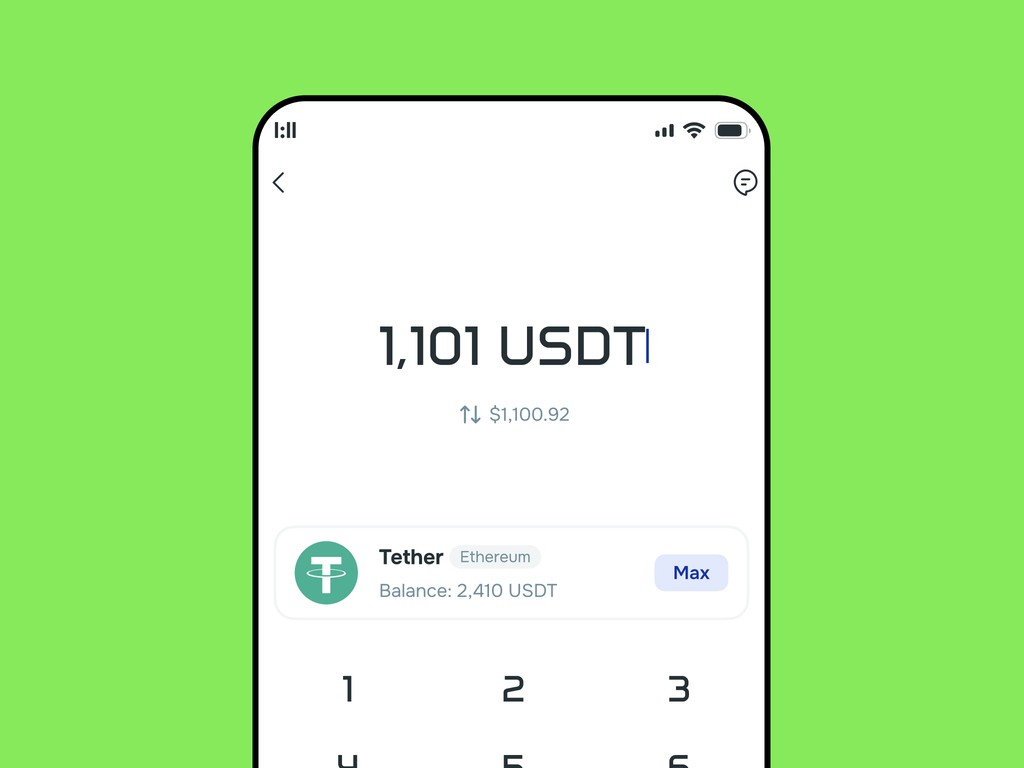
WHERE SENDING BREAKS
Why the standard crypto send flow loses everyone who isn't already crypto-native?
Every wallet in 2024 opened its send flow the same way: pick a network. Then hold that network's native token to pay gas, read a fee quoted in gwei, and confirm a transaction you can only verify on a block explorer. Four unfamiliar concepts, none of which the person asked for, all in front of the one action where mistakes are permanent.
walllet was being built for the person who already moves money in Revolut and buys on Binance. That person can hold crypto the exchange taught them that much. Sending it is where they stop, because sending is the first moment the wallet asks them to understand the machinery. A wallet whose core action only works for people who already own another wallet has no reason to exist.
The problem in one sentence: our target user could hold crypto but could not send it without learning networks, gas tokens, gwei and block explorers first.
WHAT EVM-ONLY COST
What being an EVM-only wallet forced me to cut
Two constraints shaped everything. We supported EVM chains only, so I could detect that a destination address belonged to a different chain type but could not offer to bridge to it; the flow had to stop and explain rather than solve. And fee abstraction depends on a paymaster being available on that chain, which is not guaranteed, so every fee decision needed a fallback that does not read as failure.
WHAT I CHOSE | WHAT I CUT | WHY |
|---|---|---|
Asset first, network second | Chain-first navigation | Chain-first asks a question the user can't answer. Asset-first asks one they can, then narrows the networks to the ones where they actually hold a balance. |
Fee in dollars, paid in the token being sent | Gwei and gas-limit controls | Nobody arriving from a neo-bank has ever wanted to tune a gas limit. Advanced control was deferred behind the fee row, not designed away. |
Amount and fee computed together | The insufficient-balance error at signing | An error the system can prevent shouldn't become a screen the user has to read and recover from. |
Six labelled address states | A binary safe / unsafe badge | A binary badge makes "we don't know" look like "danger", and a warning that fires on every ordinary send is a warning people learn to dismiss. |
Trust check on the receipt | Transaction hash and explorer link | Receipts get forwarded to people who may not own a wallet at all. A 66-character hash is proof only to someone already fluent. |
MY PART
What I owned on walllet's send flow
I joined walllet as its founding product designer. This was zero-to-one, no previous version to improve on, no house pattern to inherit. I worked end-to-end with the product lead and the wallet and mobile engineers, from the flow model to production specs.
WHAT I OWNED
The flow structure. asset, network, address, amount, checkout, receipt and the merged asset model that aggregates one token's balance across chains before the user ever meets the word "network". Network recommendation from the destination address type. The amount-plus-fee calculation and the behaviour of Max. The checkout fee model: dollars instead of gwei, the paymaster line, the exact-shortfall top-up. The six-state address taxonomy and every word of its copy. The receipt, Trust check, and the shareable transaction image.
An error the system can prevent should never become a screen.
FIVE DECISIONS
The five design decisions behind walllet's send flow
1. One list of assets, not one list of chains
The list opens on what the person owns. USDT is a single row with a combined balance, tagged with the number of networks it lives on. Only after choosing it does the network sheet appear and it shows only the chains where that balance actually exists, each with its own amount and estimated fee, with the cheapest one marked. The chain question still gets asked, but by then it is a comparison, not a quiz.
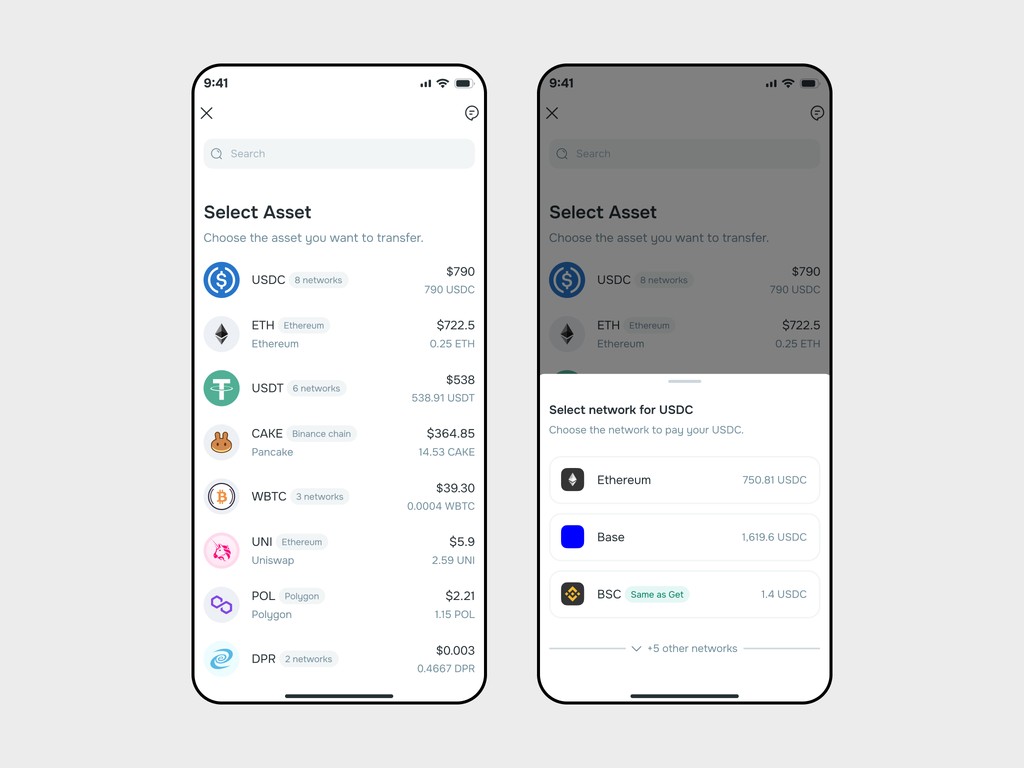
Asset first with an aggregated balance; network second, scoped to the chains holding that asset.
2. Contacts, so most sends never touch an address
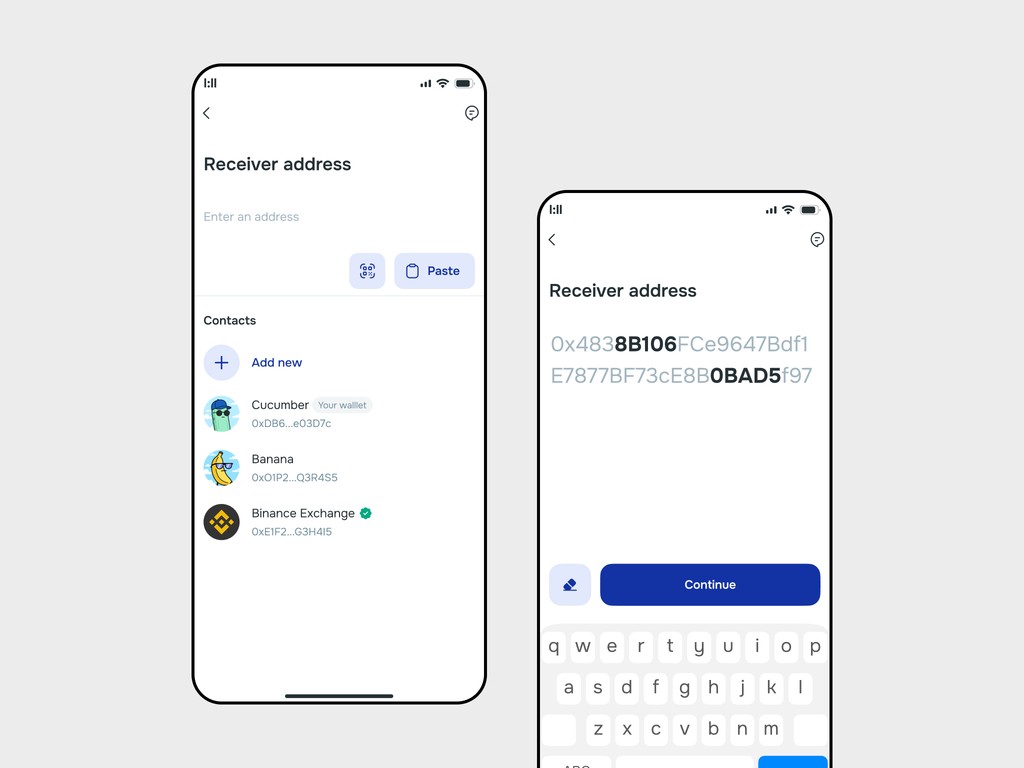
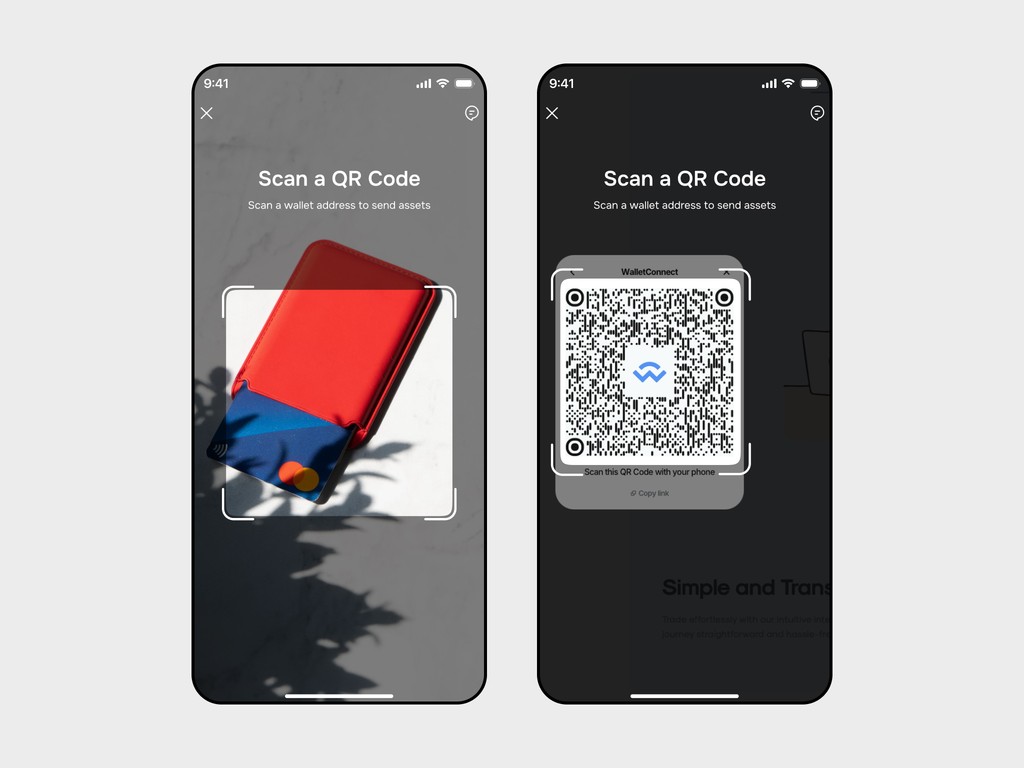
Pasting a 42-character string is the least safe step in crypto and the one every wallet treats as normal. I designed contacts the way Revolut treats payees: a saved name, an avatar, a truncated address, your own wallets grouped separately, and exchange deposit addresses carrying a verification mark. Scan and paste stay one tap away for the first send to anyone new.
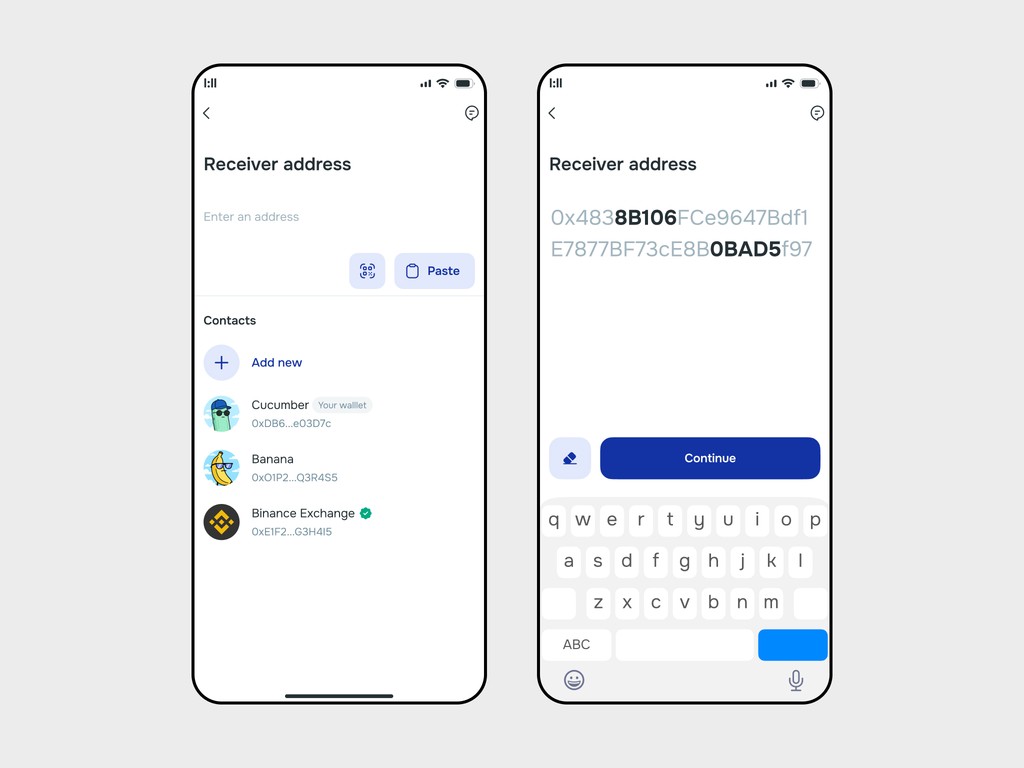
Contacts first, manual entry second; with the leading and trailing characters weighted so a visual check is possible.
3. Six things an address can be
Instead of judging an address safe or unsafe, I labelled what we could actually observe about it and let the user draw the conclusion. Known and verified addresses reduce hesitation on routine sends. New and first-time addresses add friction exactly where it belongs. Reported addresses are the only red state, which is what keeps red meaningful. The labels sit inline on the checkout, next to the address, with a tooltip in plain language, no modal, no confirmation gate.
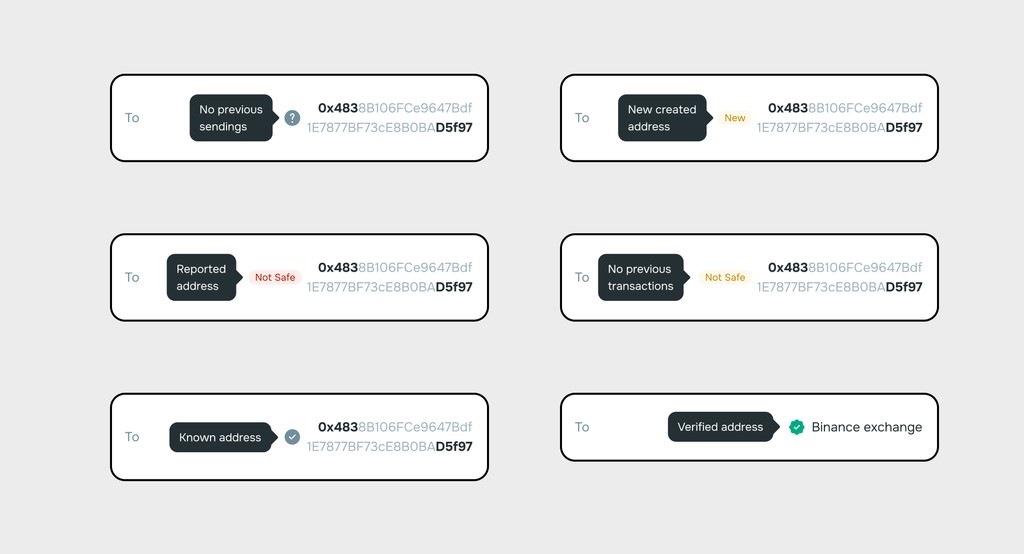
Six states, one red. Warnings only stay useful if they stay rare.
4. A fee you can read, paid with what you have
The checkout quotes the fee in dollars and names what it is paid with, because a paymaster lets the fee come out of the token being sent, the same reason nobody at an exchange is asked to keep a separate balance for withdrawals. Amount and fee are calculated together, so Max fills in a number that already clears. When it doesn't clear, the checkout says the amount was adjusted rather than silently changing it; when the paymaster can't cover the chain, it offers the exact top-up needed instead of an error.
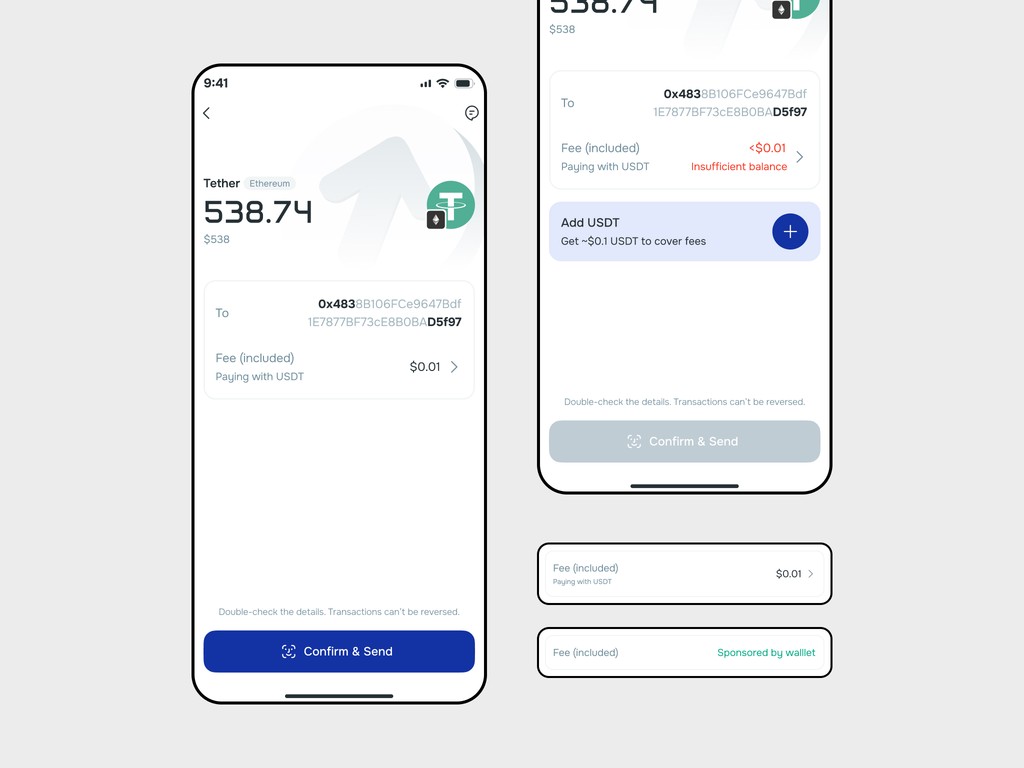
Fee in dollars, included in the amount, with the adjustment disclosed and the shortfall solved in place.
5. A receipt the receiver can read
Receipts leave the app. Someone sending a freelance payment screenshots the confirmation and posts it to the person waiting, who may have no wallet and no idea what Etherscan is. So the receipt drops the hash and gives both sides Trust check: a walllet-hosted verification page and a QR code, sitting next to the status, the time and the fee. The shared image carries the same blocks, which makes verification and distribution the same object.
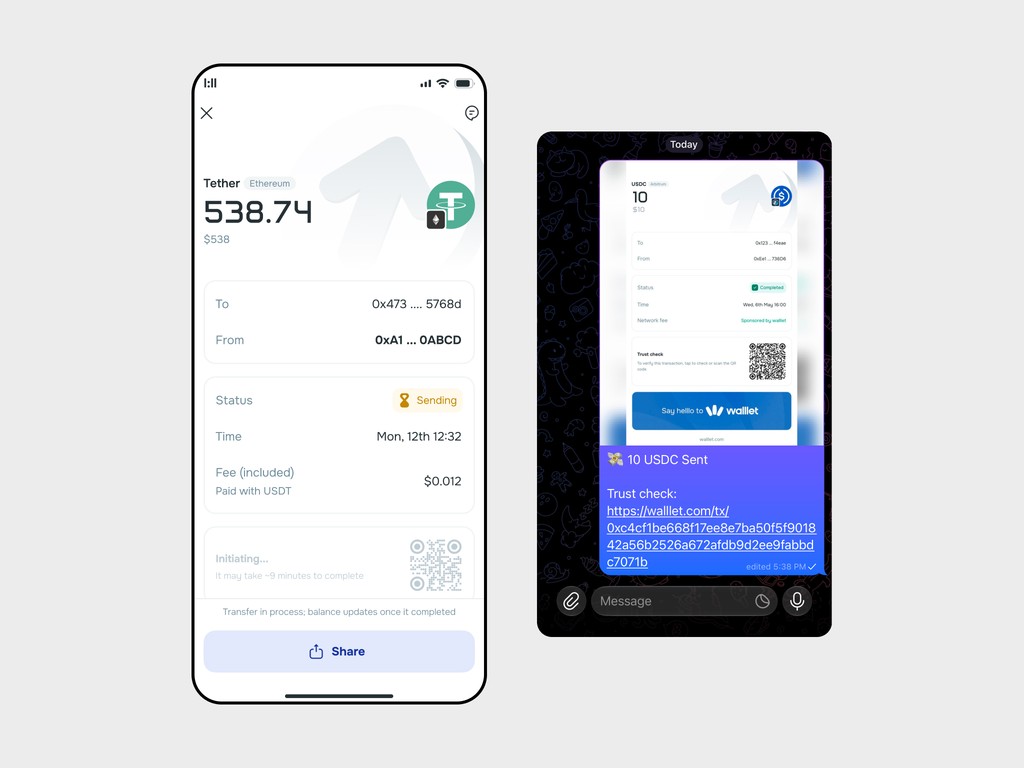
Trust check replaces the transaction hash; the receipt has to work for someone who doesn't own a wallet.

WHAT IT MADE IMPOSSIBLE
What shipped, and what the flow made impossible
This shipped as walllet's v1 send experience and set the product's defaults for everything transactional that followed. The clearest result is what the flow can no longer produce, three failures that are routine in self-custody wallets are structurally unavailable here rather than merely handled.
NoScreens where a user can pick a network they hold nothing on | NoInsufficient-balance errors reachable at signing | NoNative gas tokens a user must hold to send |
Two patterns from this flow, the merged multi-chain asset list and the dollar-denominated fee paid in the sent token, became the baseline the rest of the product was designed against, and the address-state taxonomy was reused wherever an address appears.
THE NEXT VERSION
What I'd do differently on the next version
What worked: labelling the address instead of gating it. Telling someone what is true about where their money is going, and letting them decide, held up better than a confirmation dialog would have — and it kept the one red state credible.
What I'd do differently: I designed six address states before we had an equally reliable source behind all six. "No previous sendings" is something we can always prove; "reported" depends on a list that is inherently incomplete and can quietly mislabel a legitimate address. I'd ship three states we can stand behind and earn the rest as the data source matures.
What this changed: I now ask what the data can actually prove before I design a state that claims it.
FAQ
Why does walllet.com ask for the asset before the network?
Because people know what they hold, not which chain it sits on. Selecting USDT first and then choosing from only the networks where that USDT actually exists turns an unanswerable question into a short list with balances and fees attached. Chain-first navigation, the standard in 2024 wallets, asks users to commit to a network before they can see what it costs.
How do users pay network fees without holding the chain's native token?
A paymaster covers the gas and takes payment in the token being sent, so someone holding only USDT can send USDT. The checkout shows the fee in dollars and names what it is paid with. When the paymaster is unavailable on that chain, the checkout offers a top-up for the exact shortfall instead of blocking the transaction with an error.
What are the six receiver-address states in walllet's send flow?
Known address, no previous sendings, new created address, no previous transactions, reported address, and verified address the last one naming the exchange or service when we can confirm it. Each is a label with a plain-language tooltip, placed on the checkout next to the address, not a modal that interrupts the send.
Why replace the transaction hash with a Trust check?
Receipts get forwarded. The person receiving one often has no wallet and no reason to learn what a block explorer is. Trust check gives them a tappable verification page and a QR code hosted by walllet, so the proof works for someone outside crypto while the on-chain record stays available underneath.
What was Mostafa Esmaeili's role on the walllet.com send flow?
Founding product designer, working end-to-end on the first version. He owned the flow structure, the merged multi-chain asset model, network recommendation from the destination address, the fee and paymaster model in the checkout, the address-state taxonomy and its copy, and the receipt including Trust check and the shareable image.