
Paymaster
Pay Gas fees without the gwei!
- Product
-
 walllet.com
- Role
- Product Designer
- Industry
- Finance, Banking
- Year
- 2024
TL;DR
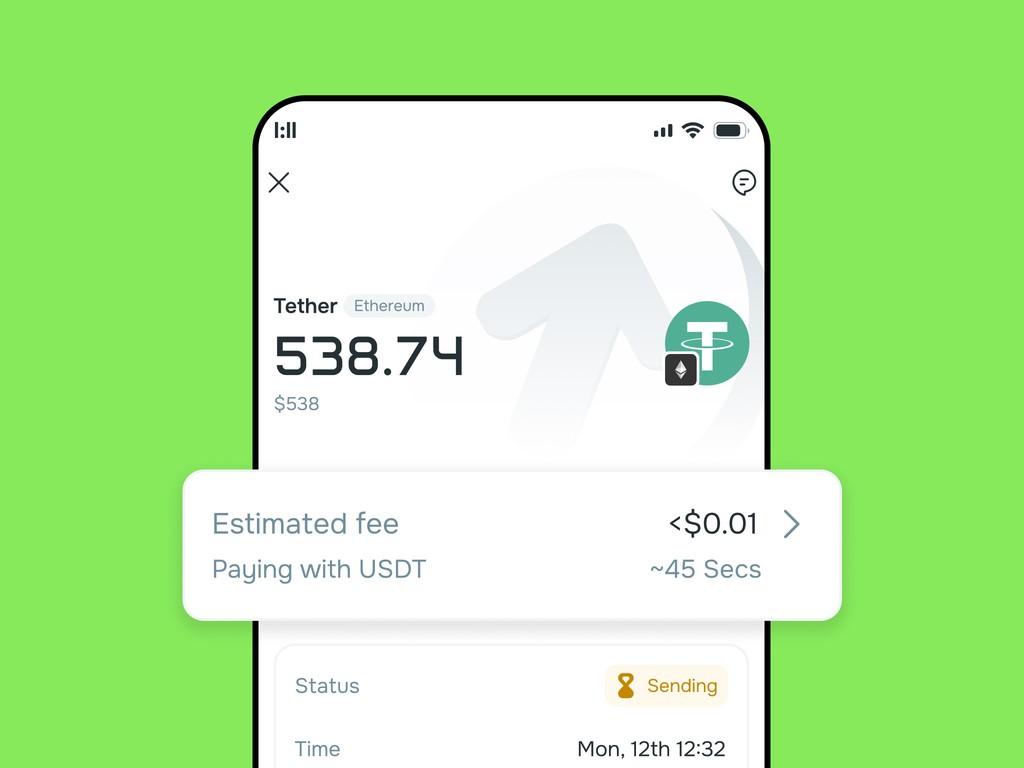
Crypto charges its fees in a currency you have to acquire separately and quotes them in a unit nobody can read. For walllet.com I designed the fee model used across every transaction in the app: the cost stated in dollars, included in the amount, and paid with a paymaster out of the token being sent, so a balance made entirely of USDT can move without first buying ETH. Nobody sees gwei.
MONEY YOU CAN'T MOVE
Why crypto fees strand people who have money
Two problems sit on top of each other here, and the smaller one gets all the attention. The visible one is the unit: fees quoted in gwei, a denomination that means nothing outside the chain and cannot be compared to anything the user already knows the price of.
The real one is the prerequisite. The fee must be paid in the chain's native token, which is a second asset the user never wanted and may not hold. Someone whose entire balance is USDT cannot move any of it — the money is visible, spendable in principle, and completely stuck until they go and acquire an unrelated coin. Nobody who learned money in a banking app has met a fee that requires a different currency, and no explanation of that makes it feel like anything other than the product being broken.
The problem in one sentence: a user could hold a full balance and still be unable to send any of it, because the fee was denominated in a coin they did not own.
HIDE, KEEP, REFUSE
What I hid, what I kept, and what I refused to hide
Fee abstraction is easy to take too far. Every removed number makes the screen calmer and the product slightly less honest, and the line between simplifying a cost and obscuring one is not obvious in a mockup. What follows is where I drew it.
WHAT I CHOSE | WHAT I CUT | WHY |
|---|---|---|
The fee in dollars | Gwei, gas limits, priority tiers | Gwei prices the chain's work, not the user's transaction. The detail sits behind the chevron on the fee row for anyone who wants it, deferred, not deleted. |
Fee paid from the token being sent | Requiring the chain's native token | A fee in a currency you must go and buy is a prerequisite, not a fee. The cost is that coverage varies by chain, which forced a fallback that does not read as failure. |
A top-up for the exact shortfall | The insufficient-balance error | An error that names a problem at the last step of a flow without solving it is a dead end wearing the costume of feedback. |
WHERE I CAME IN
What I owned on walllet's fee model
This was a pattern rather than a screen. Any feature that puts a transaction on-chain uses the same fee row, the same wording and the same fallback, so the cost of a transaction reads identically wherever a user meets one.
WHAT I OWNED
The fee row and its hierarchy, what the fee is, what it is paid with, what it costs in dollars, and the route to the underlying detail. The decision to include the fee in the amount rather than add it after. The behaviour of Max. The exact-shortfall top-up and its copy. The adjustment disclosure. And the rule that this row is the same object in every transactional flow rather than a per-feature design.
A fee you have to buy a different currency to pay is not a fee. It is a prerequisite.
ONE ROW, FOUR STATES
Four states of one fee row
The default: what it costs and what pays for it
One line answers the question, a second says which token it comes out of, and the chevron leads to the detail. "Included" is the load-bearing word the fee comes out of the amount rather than being added on top, so the number entered is the number that leaves the account.
Entering an amount you know will clear
Amount and fee are calculated together, so Max fills in a figure that already accounts for the cost of sending it. The keypad is denominated in dollars with the token amount underneath, which is the same order of priority as the fee row, value first, crypto second.
When the amount has to move
If the entered amount cannot cover itself plus the fee, the checkout adjusts it and says so on its own line. The alternative — rejecting the transaction and asking the user to work out a smaller number — puts arithmetic in front of someone who has already decided to send.
When the fee cannot be abstracted
Coverage is not universal across chains. Where it is unavailable the row turns into the smallest possible solution: the exact shortfall, offered inline, with the send button waiting rather than the flow ending. The failure state is a step, not a wall.
WHAT DISAPPEARED
What the fee model removed from the product
The clearest result is a category of support conversation that cannot happen. Nobody at walllet has to be told that their money is fine but unreachable until they buy a second coin, because the product never puts them in that position.
$The only unit a fee is ever shown in | NoSecond assets a user must hold to transact | 1Fee row shared by every transactional feature |
Because it is one pattern rather than a per-feature decision, every flow added later inherits the same answer and so does every user, who only has to learn what a fee looks like once.
THE FEE ROW, REVISITED
What I'd change about the fee row
What worked: treating the native-token requirement as the real problem and the unit as the surface one. Translating gwei into dollars would have made an unusable product readable; removing the prerequisite made it usable.
What I'd do differently: "Estimated fee (included)" asks one line to hold two ideas that pull apart. If the fee is estimated but included, the user cannot tell whether the amount they entered is final — and that amount, not the fee, is the number they actually care about. I'd state precisely what leaves the account and let "estimated" apply to the fee alone.
What this changed: I now check that the number the user is deciding on is the one stated most precisely, rather than the one that was easiest to compute.
FAQ
What is a paymaster in a crypto wallet?
A mechanism that covers a transaction's network fee on the user's behalf and takes payment in a different token at walllet.com, the token being sent. It removes the requirement to hold a chain's native asset, which is what strands people whose balance is entirely in stablecoins.
Why show network fees in dollars instead of gwei?
Gwei is a unit of account for the chain, not for the person paying. It cannot be compared to anything a user already understands, and it changes constantly. A fee quoted as $0.01 answers the only question being asked at checkout — what does this cost me — while the underlying detail stays one tap away for anyone who wants it.
Do users need ETH or BNB to send tokens on walllet.com?
No. The fee is drawn from the token being sent, so a balance made entirely of USDT can be moved without acquiring a second asset first. Where fee abstraction is not available on a chain, the checkout offers a top-up for the exact shortfall rather than blocking with an insufficient-balance error.
What happens when the amount plus the fee exceeds the balance?
The amount is adjusted to cover the fee and the checkout says so in plain language, rather than adjusting silently or rejecting the transaction at signing. Max is calculated the same way, so the figure it fills in is one that already clears.
What was Mostafa Esmaeili's role in this work?
Founding product designer at walllet.com. He designed the fee model used across the product's transactional features, dollar denomination, the fee included in the amount, the token the fee is paid with, the top-up fallback, and the disclosure shown when an amount is adjusted.