
Mobillet PFM
How I turned Saman Bank’s transaction list into a personal finance dashboard that guesses each category and learns from people’s corrections.
- Product
- Saman Bank
- Role
- Product Designer
- Industry
- Finance, Banking
- Year
- 2021-2023
TL;DR
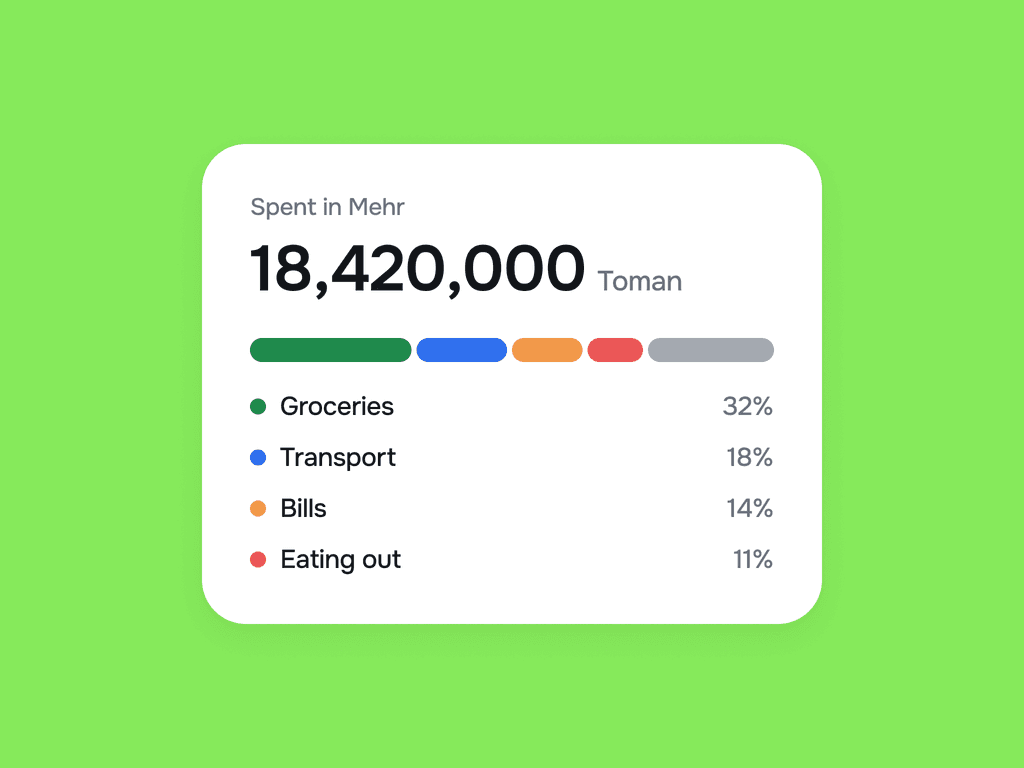
Mobillet, Saman Bank’s mobile banking app, showed customers a list of transactions and nothing else. As Saman’s lead product designer, I turned that list into a personal financial management (PFM) dashboard that guesses each transaction’s category, lets people correct the guess, and feeds every correction back in. Feature engagement rose 40%. To my knowledge, it was the first PFM in MENA to learn from its users this way.
The number came from the labels
Forty percent. The chart got the credit. The labels did the work.
That’s how much feature engagement rose after the new PFM shipped in Mobillet. Most people assumed the spending chart did it. I don’t think so. A chart is only as honest as the word under each transaction, and what people kept coming back to was the part that let them fix that word.
Why did a banking app with a full transaction list still need a PFM?
Before the redesign, Mobillet answered one question well: what happened to my account? Every card payment, transfer and bill sat in one long list, newest first. If you wanted to know how much went on groceries this month, you scrolled and did the math in your head. Almost nobody did.
For the bank, that mattered more than it looks. People opened Mobillet to do a job, pay a bill or send money, and then they left. Nothing in the app gave them a reason to open it on a day when there was no job to do.
The problem: Mobillet showed people their money, but it couldn’t tell them anything about it.
How does Mobillet decide what a transaction was for?
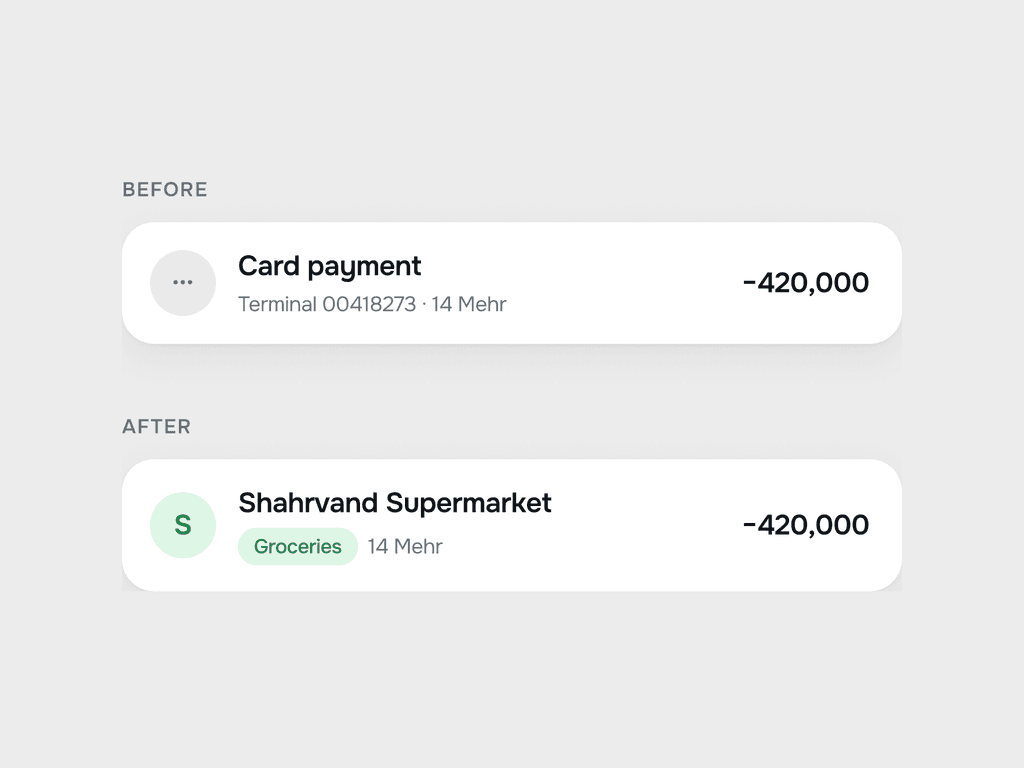
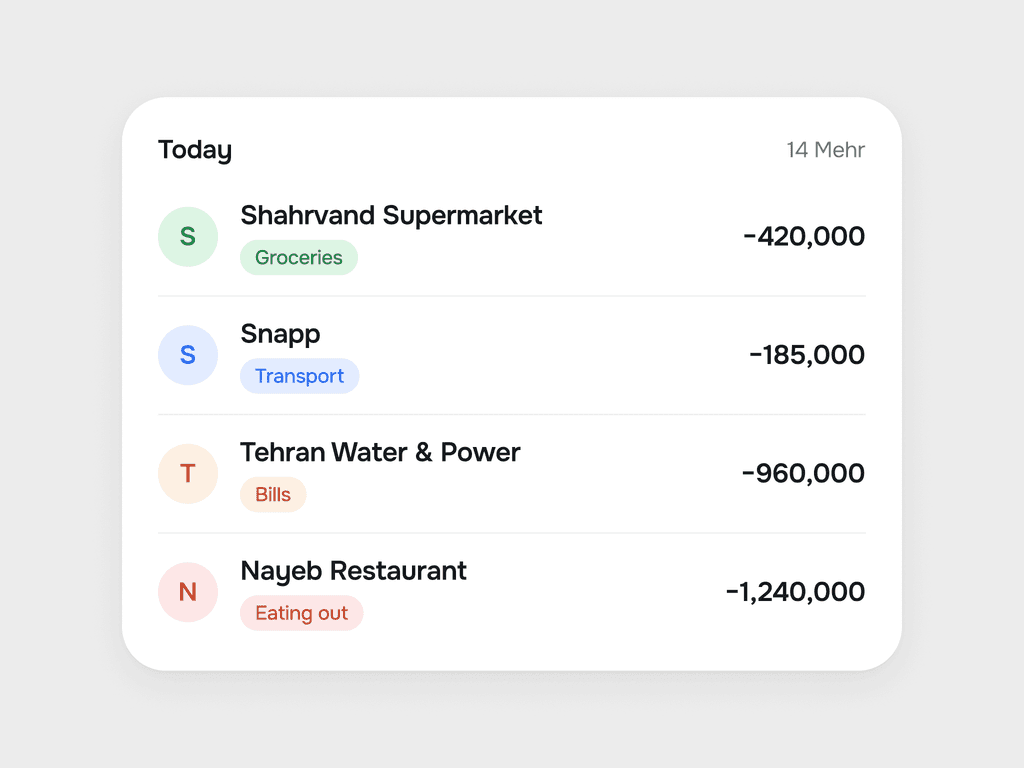
Every transaction gets a category the moment it lands, with no setup. For card payments, the merchant and terminal data were enough for a decent guess: a supermarket terminal is groceries, a fuel station is transport. The category sits right under the merchant name, so you see it in the list you already use, not in a report you have to go looking for.
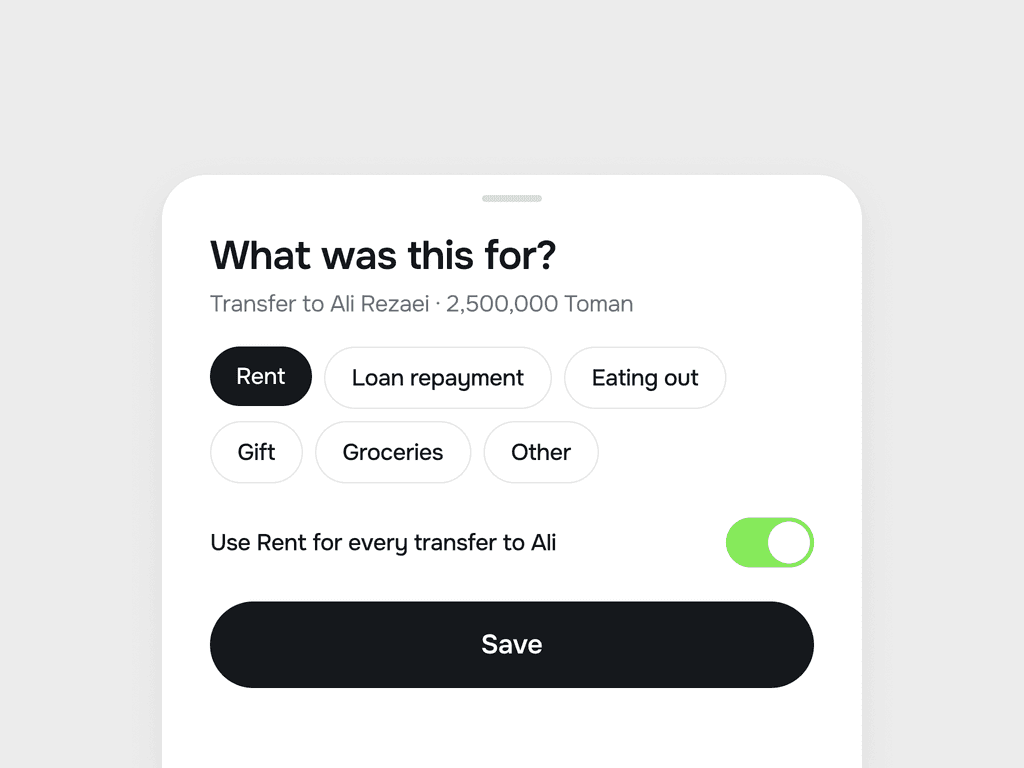
The guess is never right every time, and card-to-card transfers were the hardest part. In Iran a lot of real life runs through card-to-card: rent, splitting dinner, paying a friend back. Those transfers arrive with a name and a card number and nothing else. No merchant, no hint.
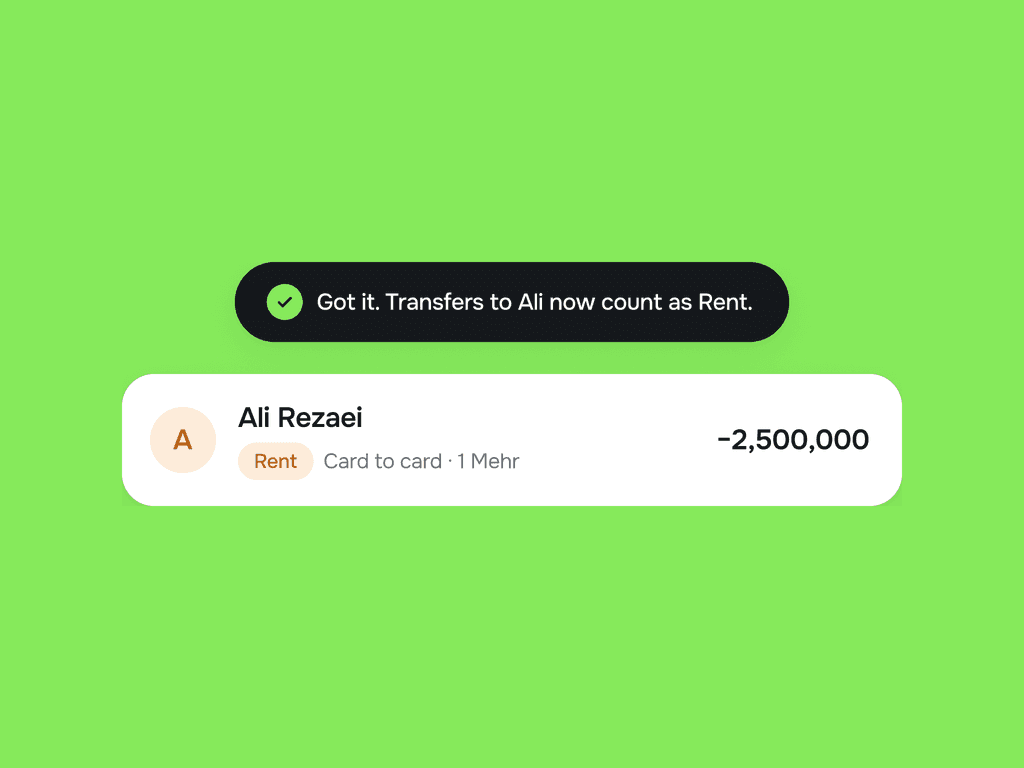
So I designed the fix to be quicker than ignoring the mistake. Tap the category, pick the right one, done. You can also tell it to remember, so every transfer to Ali counts as rent from then on. Each correction went back into the categorization, and the app got better for the people who actually used it.
What did we give up to ship it?
CHOSE | CUT | BECAUSE |
|---|---|---|
The category under every transaction, in the list people already used | A separate analytics tab as the main way in | People lived in the transaction list. The label had to meet them there. |
One-tap correction that remembers the merchant or the person | Asking people to set up categories and budgets before they saw anything | Setup screens are where PFM features go to die. Value first, settings later. |
A plain “Transfer” label when we couldn’t guess | Guessing card-to-card transfers anyway | A confident wrong label costs more trust than an honest blank one. |
Budgets and saving goals were on the list for the first release too. I cut them. Without categories people trust, a budget is just a number that’s wrong in a new way.
Which version won, and what did the 40% measure?
We tested two versions before rolling it out. One put spending behind its own tab, with a big chart up front. The other kept people in the transaction list, with the categories inline and a short monthly summary on top. The second one won, and it drove a 40% increase in feature engagement.
It also shipped as part of a bigger change. In the same period I redesigned Mobillet end to end and built Saman Bank’s first design system, so the PFM never felt bolted on. For the growth side of the same app, see the Mobillet referral engine. The idea of putting a human label on a raw record came back years later in my crypto work, in address labeling for walllet.com. The rest of my history is on my resume.
The part with my fingerprints
I was Saman Bank’s lead product designer, responsible for four banking products at once, and the design team grew from two people to eight while this was happening. On the PFM, the category row, the correction flow and the monthly summary were mine, from the first sketch to the last edge case. Designers on my team took the category icons and the empty states. Engineering owned the categorization rules, and some of the best edge cases came from them, like a refund showing up as income or a transfer you send to your own second card.
What the 40% didn’t tell us
I expected the monthly chart to be the star. It wasn’t. People glanced at it and went straight back to the list to check the labels and fix the wrong ones. If I did it again, I’d track the correction rate as a product metric from day one. How often people fix a category tells you how much they trust everything else on the screen, and we started looking at it too late.
FAQ
What is Mobillet?
Mobillet is Saman Bank’s mobile banking app in Iran. It covers cards, transfers, bill payments and personal finance tools, and it received a Best Banking App of the Year award.
What does a PFM dashboard do in a banking app?
A personal financial management (PFM) dashboard sorts transactions into spending categories and shows where the money goes each month, so people don’t have to export statements or add things up themselves.
How did the Mobillet PFM categorize transactions?
It gave every transaction a category automatically, using the merchant and terminal data on card payments. People could correct any category in one tap, ask the app to remember that choice for a merchant or a person, and every correction fed back into the categorization.
What results did the PFM produce?
The winning version, with categories inside the transaction list and a short monthly summary on top, drove a 40% increase in feature engagement.
What was Mostafa Esmaeili’s role?
Mostafa was Lead Product Designer at Saman Bank from February 2021 to January 2023, leading design for four banking products at once, including Mobillet. He designed the PFM’s category row, correction flow and monthly summary, and grew the design team from two to eight designers.