
Merge Token & Chain
One asset, many chains
- Product
-
 walllet.com
- Role
- Product Designer
- Industry
- Finance, Banking
- Year
- 2023
TL;DR
walllet.com lists crypto by asset, not by chain. USDT is one row with one balance wherever it lives, and the chain surfaces on the token page and at the moment a transaction needs it. In 2023 I designed this merged asset model and the rule that governs it — what merges, what never does, and where the per-chain truth stays reachable — then applied it across home, search, send, receive and swap.
THREE USDT ROWS, NO TOTAL
Why listing crypto by chain makes a wallet unreadable for everyone else
Wallets list positions, and a position is a token on a chain. Someone holding USDT on Ethereum, Polygon and BNB Chain opens their wallet to three USDT rows, three balances, and no total. Hold eight tokens across four chains and the home screen becomes a reconciliation exercise before it is a wallet.
That is an accounting artefact leaking into the interface. The person we were building for — habits from Revolut and Binance — has one USDT balance in their head, and home is the first screen they land on after onboarding. Every feature inherits that list too, so this was either fixed once in the model or worked around five times in the UI.
The problem in one sentence: our users think in assets, and every wallet on the market listed chains — turning one balance into three rows and the home screen into arithmetic.
THE DANGEROUS SHORTCUT
Why merging tokens by name would have been dangerous
The obvious implementation is to group rows by ticker. It is also the one that gets people robbed: anyone can deploy a contract called USDT with the right icon, and symbol-matching would fold it into a real balance. Merging had to be a verification question, not a string comparison and that set the cost of everything else.
WHAT I CHOSE | WHAT I CUT | WHY |
|---|---|---|
Merge only verified contracts on verified chains | Merging by ticker symbol | A copycat contract must never inherit a real token's row. The cost is a maintained verification list, and a legitimate token on an unverified chain sitting apart until it is added. |
Chain on the token page and at transaction time | Chain as a navigation layer | Crypto-native users need the per-chain truth and deserve to get it. They just don't need to walk through it to reach their own balance. |
Cross-chain swap | Same-chain swap with a chain picker | One balance implies one swappable balance. A chain picker inside swap would have exposed the fragmentation the model exists to absorb, and pushed the complexity back onto the user instead of into routing. |
One entity and one rule for all five surfaces | A list design per feature | Five asset lists that each behave slightly differently is how a wallet becomes confusing without any single screen being wrong. |
OWNERSHIP
What I owned on walllet's asset model
I joined walllet as its founding product designer. This was a model decision before it was a screen decision, cheap in month one, structural by month six.
WHAT I OWNED
The asset entity itself: aggregated balance, the network badge, and how rows sort. The merge rule and its boundary, verified contract on a verified chain merges, everything else keeps its own row. The token detail page as the per-chain source of truth. The points where chain re-enters the interface and what it must show when it does. And the written pattern that designers and engineers built against, so home, search, send, receive and swap render one list rather than five.
Chain never disappears. It stops being the way you navigate.
THE PATTERN
How the merged asset model behaves on each surface
Home: one row, one balance, one badge
Each asset is a single row with its combined balance. The badge next to the name carries the whole compromise: it names the chain when there is one, and reads as a network count when there are several. It never pretends an asset lives in one place, it declines to make that the user's problem on the first screen. Tapping through opens the token detail page, where the balance breaks out per chain.
Search: you find assets, not positions
Searching USDT returns USDT, one result, one balance, the row they already recognise from home. Returning three results for a token someone holds once in their mind teaches people the product is more complicated than their goal.
Send: asset first, then the chains that actually hold it
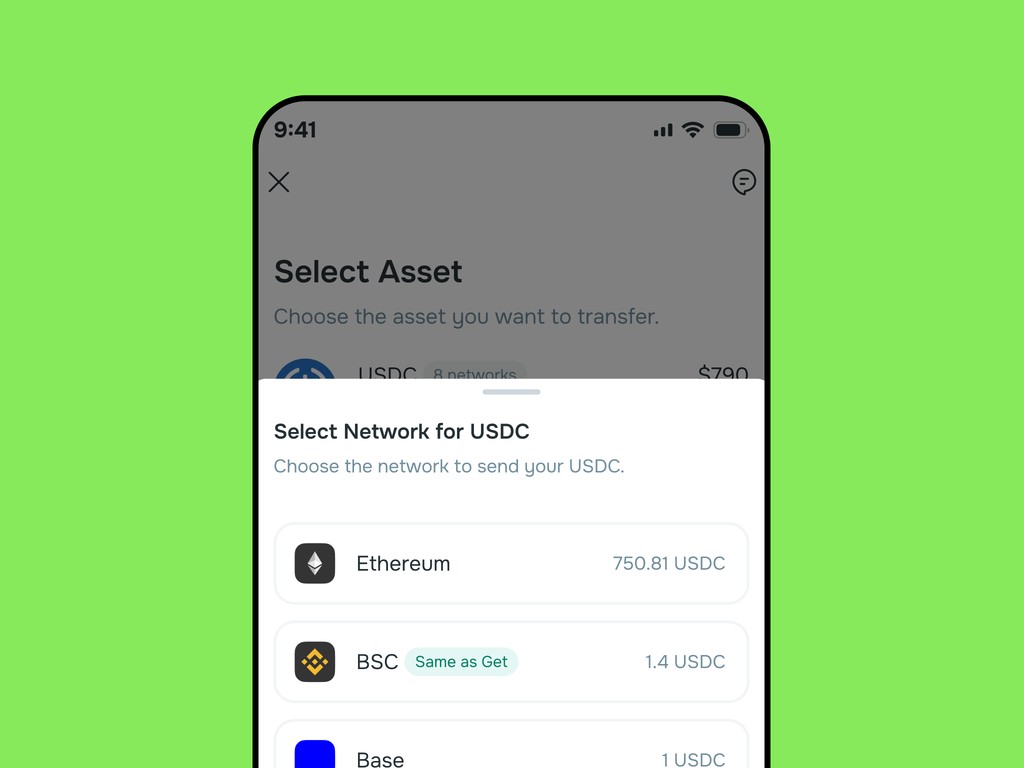
Choosing the asset comes first; the network sheet opens second and lists only the chains carrying a balance, each with its own amount and estimated fee, cheapest marked. This is the model's argument in miniature: the chain question still gets asked, but by then it is a comparison rather than a quiz.
Receive: the same entry point
Receive starts from the asset too, so the mental model holds in both directions rather than reverting to a chain menu the moment money comes back the other way.
Swap: a merged balance behaves like one balance
Swaps route across chains the way they do on an exchange. Someone swapping USDT for ETH picks two assets, not two networks, and the routing resolves where each side sits. Had swap required both sides on one chain, the merged balance would have been a promise the product broke at the first interesting moment.
WHAT SHIPPED
What shipped and what it removed
The model shipped as a documented pattern rather than a screen, which is why it holds across five surfaces built by different people at different times. Its effect shows clearest in what the product can no longer do to a user.
1Row per asset, whatever the number of chains behind it | 1Merge rule shared by home, search, send, receive and swap | 0Unverified contracts able to enter a verified asset's row |
The middle number is the one that compounds: every feature built after this inherited a settled answer to "how do we list assets?", so the argument happened once instead of at every kickoff.
WHAT I'D REVISIT
What I'd change about the merged asset model
What worked: treating the merge as a verification decision rather than a display one. Safety rule and interface rule became the same rule, so no version of the UI could be right while being unsafe.
What I'd do differently: the network badge does too much. "3 networks" says an asset is multi-chain but not whether that matters where you are standing. I'd specify it per surface — a count on home, where it is context; the chains actually holding a balance inside send, where it is a decision.
What this changed: I now define the entity and its rules before I design the list that shows it.
FAQ
What is a merged asset model in a crypto wallet?
It lists one row per asset instead of one row per position. A user holding USDT on Ethereum, Polygon and BNB Chain sees a single USDT row with a combined balance and a badge showing how many networks it spans, rather than three separate entries they have to add up. The chain is still there — it moves to the token detail page and to the moment a transaction actually needs it.
How does walllet.com stop a scam token merging into a verified asset?
Merging is a verification question, not a string match. Only contracts verified for that asset on verified chains merge into one row. A contract that copies a real token's name and icon is not verified, so it can never inherit that token's identity or balance — it stays a separate row with its own name.
Can users still see which chain their balance sits on?
Yes. The token detail page breaks the balance down per chain, and any action that depends on a chain shows the chains with a balance, each with its own amount and estimated fee. Chain is never hidden; it stops being the thing you navigate by.
Does merging assets break swap?
It would if swap forced both sides onto the same chain. walllet handles swaps across chains the way an exchange does, so a merged balance behaves like one swappable balance. Blocking a cross-chain swap would have exposed exactly the fragmentation the model exists to absorb.
Which parts of walllet.com use the merged asset model?
Home, search, send, receive and swap all read from the same asset entity and the same merge rule, documented as a pattern so designers and engineers build one list rather than five. Mostafa Esmaeili designed the model and its rules as walllet's founding product designer in 2023.