
Contacts
Paying a name, not an address
- Product
-
 walllet.com
- Role
- Product Designer
- Industry
- Finance, Banking
- Year
- 2023
TL;DR
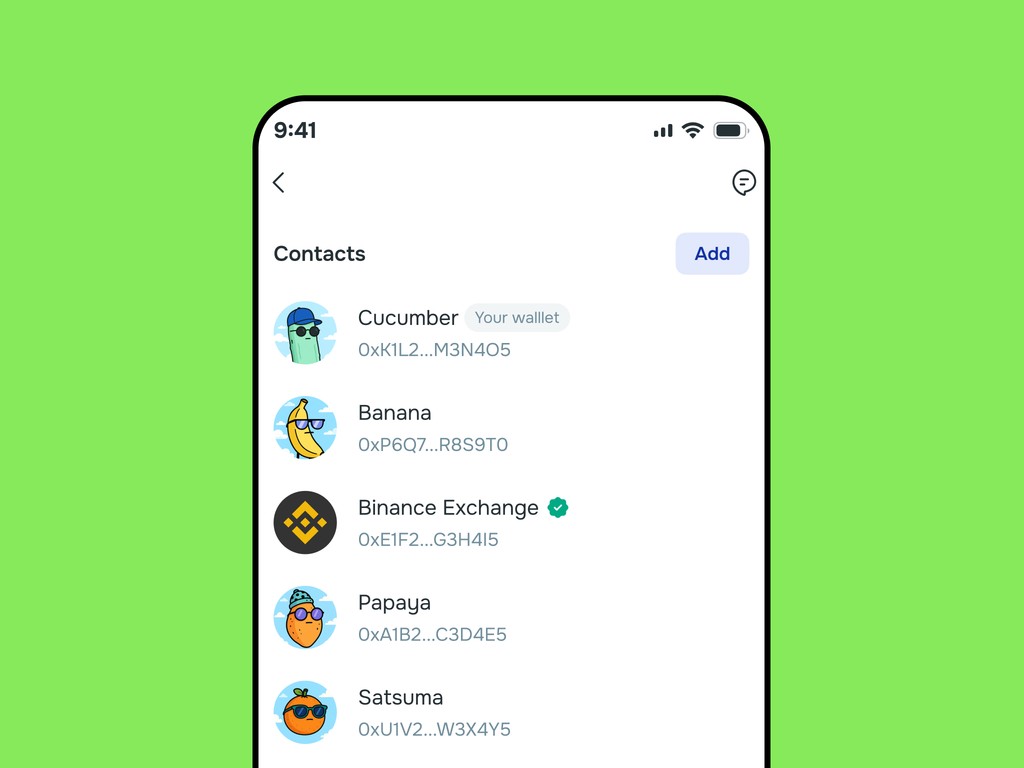
Pasting a 42-character address is the least safe step in crypto, and every wallet treats it as routine. For walllet.com I designed contacts as a payee book: people and services saved under a name and an avatar, with every address a contact owns collapsed into one entry, and the user's own wallets sitting in the same list. Exchange deposit addresses are recognised and saved automatically as verified contacts.
THE MOST DANGEROUS INPUT
Why the address field is the most dangerous input in crypto
An address is unreadable, unmemorable and uncorrectable. One wrong character sends money to a destination that exists, belongs to nobody reachable, and cannot be recalled. The industry's answer has been to ask the user to check it, compare the first four characters and the last four, or trust whatever is on the clipboard. That is a person doing a machine's job, on the one action with no undo.
It gets worse with repetition. The send our users make most often is a deposit to their own exchange account: the same destination, over and over, re-pasted every time. That is also precisely what clipboard-hijacking malware waits for. The highest-frequency send in the product was also its highest-risk one, and it was being handled by copy and paste.
The problem in one sentence: the address field asked our users to visually verify 42 characters they cannot read, every time, on the one action that cannot be undone.
WHAT A NAME COSTS
What I gave up to make a contact mean a person
A contact book is easy to build badly. Store one entry per address and the list becomes as fragmented as the addresses it was meant to replace. Verify everything and the verification mark stops meaning anything. Both failures come from the same instinct — letting the data model choose the interface — and both were live decisions here.
WHAT I CHOSE | WHAT I CUT | WHY |
|---|---|---|
One contact holds every address that belongs to it | One entry per address | People think in people and services, not keys. The cost lands on the contact record, which then has to resolve which of its addresses applies to the transaction in play. |
Recognised exchange addresses saved automatically | Asking the user to save them | The destination someone uses weekly should never need manual filing. The cost is that automatic entries must read as different from ones the user typed. |
The verified mark only where the service can be confirmed | A trust score on every contact | A mark that appears on everything communicates nothing, and a name the user typed must never borrow authority the product did not verify. |
Own wallets inline, tagged | A separate accounts screen | Moving funds between your own wallets is the same task as paying someone. Splitting it into a second screen adds a decision before the user has done anything. |
MY ROLE
What I owned on walllet contacts
WHAT I OWNED
The contact model — one contact, many addresses — and what a contact record has to carry to be recognised at a glance. The automatic verified exchange contact and the visual line between it and a user-created one. Own wallets grouped inline with a tag rather than exiled to their own screen. The hierarchy of the address screen, where contacts are the default and scanning and pasting are the fallback. And the link between a contact's status and the receiver-address label that appears later, at checkout.
The address someone pastes most often is the one they should never have to paste.
PEOPLE BEFORE KEYS
How the address screen puts people before keys
Contacts are the default state of the screen, not a feature parked behind a button. The empty field sits at the top for the send that genuinely is new, with scanning and pasting beside it, and everything below is people. A name and a face do the recognition work forty-two characters cannot, and the truncated address stays visible underneath for anyone who wants to confirm it.
Status travels with the contact. A saved contact and a verified exchange both change what the user sees at checkout, the same address that would otherwise read as unfamiliar arrives labelled, next to the amount, at the moment of confirmation rather than in a warning nobody asked for.
What contacts removed from the send flow?
Contacts changed the shape of the address step rather than decorating it. The clipboard stopped being load-bearing, and the two sends our users repeat most — paying the same person again, and topping up their exchange account — stopped requiring the riskiest interaction in the product.
1Tap to repeat a send that previously meant a paste | 0Manual steps to save a recognised exchange address | 0Verification marks on contacts the product cannot confirm |
What I'd change about the contact model?
What worked: creating the verified exchange contact for the user instead of waiting to be asked. The destination people paste weekly is the one that should have been saved for them the first time.
What I'd do differently: I designed a contact that holds many addresses before deciding how it picks between them. The resolution rule ended up settled downstream, inside the send flow, which meant the contact record was defined by what it stores rather than by how it is chosen from. I'd write the selection rule into the model first.
What this changed: I now specify how an entity gets chosen at the same time as what it holds.
FAQ
Why do crypto wallets need a contacts feature?
Because the address field asks people to verify 42 characters they cannot read, on an action that cannot be reversed. A contact replaces that check with recognition: a name, an avatar, and a saved address the user has already paid successfully. After the first send to someone, no further send should touch the clipboard.
What does it mean to merge addresses into one contact?
A contact is a person or a service, not a key. Every address that belongs to them sits under a single entry, so the user picks who they are paying and the wallet resolves which address applies. Listing one entry per address would rebuild the fragmentation the contact exists to remove.
How does walllet.com create verified contacts automatically?
Exchange deposit addresses are recognised and saved as contacts carrying a verification mark that names the service. Depositing to an exchange is the send our users repeat most, and it is the one clipboard-hijacking malware targets, so it is the worst possible thing to leave as a manual paste.
How is a verified contact different from one the user added?
The verification mark is only applied where walllet can confirm the service behind the address. A contact the user names themselves is trusted because they created it, not because it was verified, and the interface keeps that distinction visible so a typed name can never borrow authority it has not earned.
What was Mostafa Esmaeili's role on walllet.com contacts?
Founding product designer. I designed the contact model, the automatic verified exchange contact, the grouping of the user's own wallets inline with their payees, and the way contact status carries through to the receiver-address label shown at checkout.